
 México
If a European club were to pay €15 million for Gilberto Mora tomorrow, most people would say it was buying a 17-year-old footballer.
In reality, it would be buying something very different: more than a decade of accumulated investment. Training hours, multidisciplinary support teams, sports infrastructure, youth tournaments, medical care, specialized nutrition, and hundreds of people making decisions over many years to develop a talent that, for a long time, generated no visible economic return. Mora is now considered one of the brightest prospects in Mexican football, but his current value did not begin when he debuted for the Mexican National Team. It started long before that.
Ten Years Before the Applause
Professional football has something in common with the best business decisions: results usually arrive long after the initial investment. When Club Tijuana brought Mora into its development system, there was no guarantee that he would reach the first team, much less represent Mexico on the international stage. Nevertheless, the club committed resources to his development for years, knowing that most young players who pass through a professional academy will never reach that level.
From a business perspective, the model resembles a venture capital fund more than a traditional hiring process. Clubs develop dozens, sometimes hundreds, of players with the expectation that a small number will generate enough value to justify the cost of the entire system. It is the same logic that drives a technology company to fund multiple projects knowing that not all of them will succeed. The difference is that the asset being developed is not a product or a patent—it is a person.
The Real Business Isn’t in the Salary
This is why it can be misleading to focus exclusively on a player’s salary. While contracts tend to attract headlines, they are rarely the most important factor from a club’s perspective. What truly matters is the appreciation of the asset. Every step in a player’s career changes his market value: making a professional debut, establishing himself in the first division, representing his national team, and attracting the attention of international clubs. Each milestone increases perceptions of what he might become in the future.
That logic explains why international appearances carry such significant economic importance. When a player steps onto the field for the Mexican National Team, he is not only competing for a sporting result. He is also presenting himself to a global network of sporting directors, scouts, sponsors, and analysts who are trying to answer a simple question: how much value could this player generate five years from now? In other words, the market is not evaluating the present alone—it is evaluating potential.
When Talent Becomes a Return
The case of Santiago Giménez helps illustrate this phenomenon. His transfer to Feyenoord was not simply the sale of a striker developed by Cruz Azul. It was the moment when years of investment in player development began to generate a measurable financial return. What the Dutch club acquired was not only the player’s immediate performance, but also the growth potential associated with a talent that had been nurtured for years. The deal highlights one of the defining realities of modern football: the most successful clubs do not compete solely on the pitch. They also compete in their ability to identify, develop, and increase the value of talent before anyone else does.
This is why youth academies are far more than sporting programs. They are platforms for value creation. Revenue streams from transfers, sponsorships, image rights, merchandise sales, and media exposure can turn an exceptional player into one of the most profitable assets within a sports organization. When clubs search for the next great prospect, they are not simply looking for the next goalscorer. They are looking for an investment capable of multiplying its value over time.
What Football Reveals About Business
Gilberto Mora’s story is particularly interesting because it makes visible something that happens every day inside organizations. When a company develops a new product, prepares a future leader, or launches a new business line, the results often appear sudden to outside observers. In reality, they are usually the outcome of years of quiet work, committed resources, and decisions made without any guarantee of success.
Football simply makes this process easier to see. A teenager walks onto the pitch wearing his country’s jersey, and it appears as though success arrived overnight. In reality, that moment is backed by a decade of accumulated investment. Perhaps that is the most valuable lesson of all. The most important assets rarely deliver immediate results. For a long time, they look like expenses. Only later do they become a competitive advantage. And the people and organizations that understand that distinction are often the ones that build something far more valuable than a short-term victory: they build value that continues to grow long after the applause has ended.
¡Comparte esta entrada, elige tu plataforma!
Related

The Business of Nostalgia: What Nintendo Teaches Us About Consumer Behavior
The most successful companies do not always create something entirely new. Sometimes, they achieve something even more powerful: reconnecting customers with emotions and memories they thought they had left behind. Recently, Nintendo announced a new version of The Legend of Zelda: Ocarina of Time, one of the most influential video games in history, originally released

Why Your Next Sale May Depend More on AI Than Google
Not long ago, the formula for selling was straightforward: optimize your website, invest in keywords, and compete for a spot among Google’s top search results. Your customers would browse multiple tabs, read blog posts, and compare options on their own. Today, the rules of the game are changing. Anyone selling products or services can already

Anti-Marketing: Why Perfection Is Killing Your Business
The marketing world is divided into three camps: polished, carefully crafted, highly produced campaigns that are, above all, extremely expensive; digital nomads who can generate an entire campaign with a single click using AI-created content; and finally, those who have realized that today’s trend is all about what feels real, human, and not something produced

Farewell Message from Carlos Güereca, Founding Rector of Rochat School of Business
Dear Rochat School of Business Community, Today, I address you with mixed emotions. On one hand, I feel profound gratitude as I reflect on the journey we have traveled together. On the other, I feel a deep sense of confidence knowing that our institution is strong, thriving, and well positioned for the future. As of
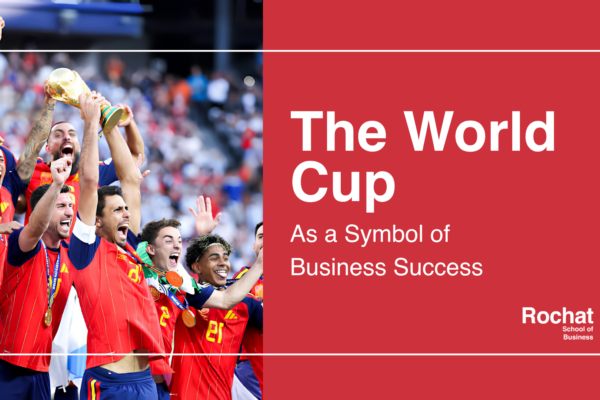
Winning the World Cup: When the Trophy Is Not the Point
When a country wins the FIFA World Cup, most people focus on the obvious image: a group of players lifting a trophy in front of millions of viewers around the globe. But if you look at it from a business perspective, something much more interesting is happening. In reality, an organization has won an award.

The invisible cost of mobile registration: what it really means for your operation
There is one decision your company probably assumes is settled: connectivity. Yet, there is a very high probability that, in the short term, a part of your operational force and your customer base will lose the signal on their phones. The obligation to link every mobile line to a National Identity Document (CURP) seems, on